How Risky Is Kenyan Real Estate Right Now?
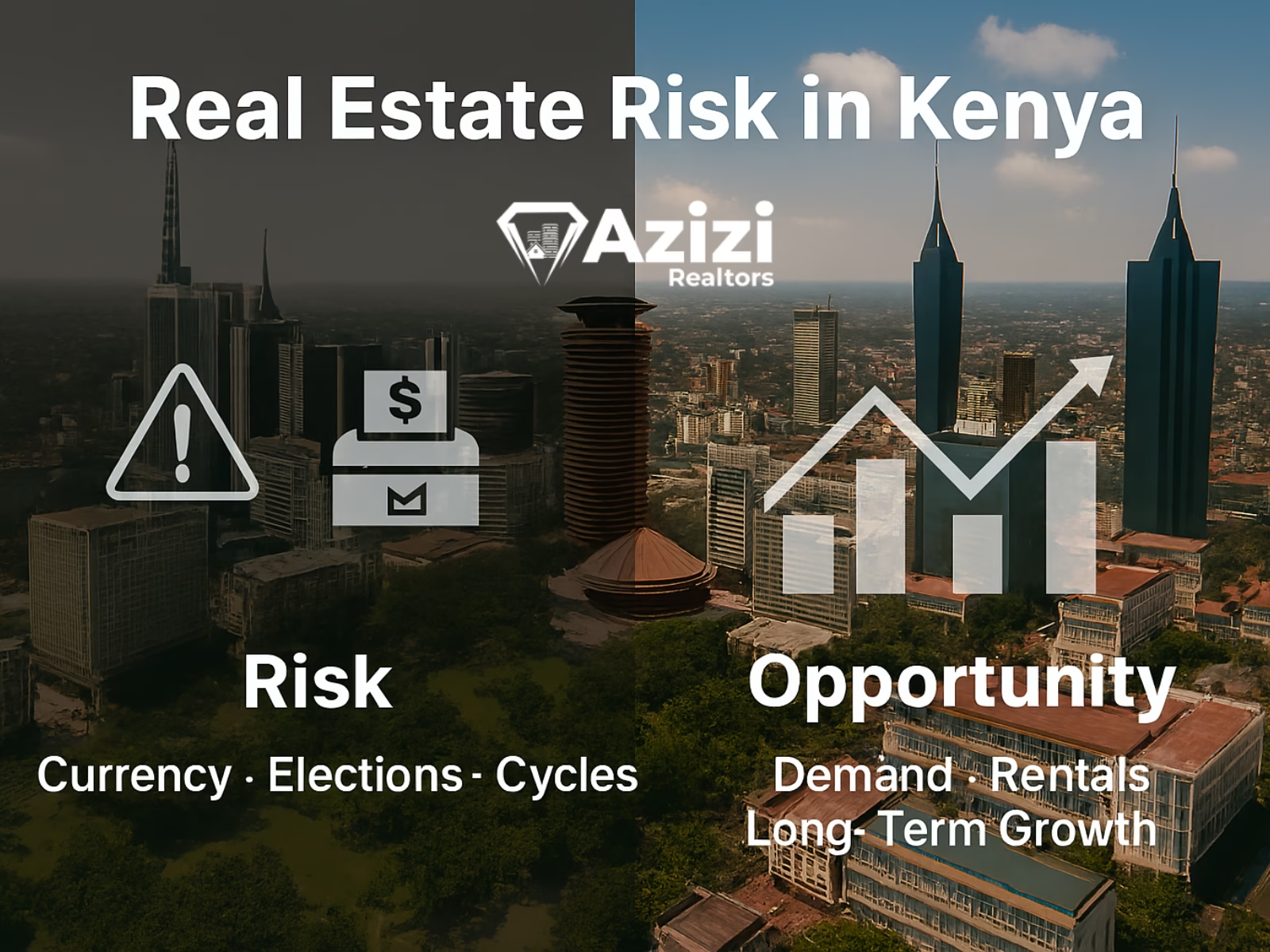
The risks surrounding Real Estate in Kenya is a growing conversation as we move through 2026. Now the property market is entering a noisy and emotional moment.
We have global analysts warning us on a possible property cycle correction around 2026 with headlines talking about the real estate bubbles. Additionally, Kenya is approaching the election period that often brings uncertainity. Then add currency swings and memories of the 2008 global housing market crash.
Hence the critical question by investors:
Is investing in Kenyan real estate a risk or a reward?
At Azizi Realtors, we believe informed investors outperform fearful ones. Yes, real estate in Kenya has real risks but also durable opportunities. The key in investing despite the noise is not ignoring the risk but understanding it, pricing it, and managing it.
This blog will break down:
- Property cycles and the “18-year theory” in relation to Kenya
- Past downturns and what we learned from the 2008 housing crash
- The real risks that investors face today like politics, market cycles, currency risks
- Why strategic investors are still buying in 2026
Looking Back To Look Forward: Lessons 2008 Taught Kenya
The 2008 housing market collapse reshaped real estate markets worldwide. In many countries the property values tumbled, banks failed and global credits froze. Kenya wasn’t at the epicenter of the storm but still felt the ripple effects by:
a. Credit Crunch
This meant tighter liquidity with access to credit finance becaming more constrained and commercial banks in Kenya high-risk-averse.
b. Loans by Bank
Banks were more cautious with lending loans. The interest rates in loans increased with credit to the private sector stifled.
Due to the crisis banks opted to shift investments towards safer government securities.
c. Reduction in Diaspora Remittances
North America and Europe were the regions hit the hardest with the crash. The Kenyans living in these regions faced a reduction in their income and possible job losses. This hampered the mortgage lending to the Kenyan diaspora.
d. Cautious buyers and investors
The country saw a temporary stagnation in high-end developments since investors delayed in making decisions. There sale of properties also slowed down.
e. Overal decline in GDP growth
Alongside the global crisis, the 2007/2008 post-election violence and the severe drought slumped Kenya’s economic growth from 7.1% in 2007 to 1.7% in 2008.
So, what is the main lesson for Kenyan investors?
Simple, real estate isn’t all risk-free but tends to survive shocks. If we fast-forward to 2026 and the global environemt is feeling uncertain again with louder conversations on property bubbles.
Unlike 2008, to mitigate real estate risk in Kenya investors have:
- Affordable housing and infrastucture that supports long-term demand.
- Market transparency and data than before.
- A growing investment base of diaspora investors seeking verified assets.
The key takeaway is that historically real estate in Kenya has experienced corrections but not collapses.
18-Year Property Cycle Theory
The 18-year property cycle theory is a concept that has resurfaced in 2026. This concept suggests that over 18 years real estate markets move through predictable long-term phases:
- Boom
- Peak or Slowdown
- Correction
- Recovery
The global analysts applying this theory point at 2026 as a potential correction period. While theories help with understanding cycles they are not always guarantees. In the Kenyan market, our fundamentals differ from Western economies.
Although no model is perfect, this theory highlights some truths that cannot be ignored:
- They are no straight lines in property markets as they move in cycles
- Corrections or slower growth follow periods of rapid growth
- Long-term, timing and entry price matter in real estate
While no model is perfect, the theory highlights some useful truths:
How does the property cycle relate to Kenya?
With the rise of Nairobi suburbs, luxury homes, satellite towns and new infrastructure, Kenya has experienced long-term phases of rapid appreciation.
Similarly, there has been a cooling-off period where prices have stagnated with buyers becoming more cautious. This is seen in areas of oversupply or speculative segments.
Investors shouldn’t panic at the word “cycle” but can ask these questions:
- Are rental yields, incomes, actual demand, and infrastructure supporting the current price?
- Depending on the assest type and given location, where are we in the local cycle?
- Will I be able to hold this asset for at least 7-10 years if a correction occurs?
Instead of viewing 2026 as a doomsday prediction, smart and strategic investors are seeing it as a cycle-awareness checkpoint for real estate.
Kenya’s property market reality:
- Diaspora investments remain strong and diaspora remittance grows our economy
- Annual rise of urban migration with youth migration being the highest
- The demand for housing still outpaces supply
- Real estate is a hedge against inflation
Kenya’s property market is more likely to experience:
- Strong performance in areas and developments that are well-located and well-priced
- Correction of prices in speculative segments
- Oversupplied areas will have slower absorption
Key Risks in Kenyan Real Estate
Despite offering strong long-term fundamental, Kenyan real estate faces real risks and 2026 bring some into shaper focus.
1. Currency Risk
Local and diaspora investors should both consider currency volatility. If the Kenyan Shilling is weak it can affect returns especially when the rental income or resale profits are converted back to foreign currency. It can also affect foreign currency loans by increasing the debt-servicing costs.
In addition, investors relying on foreign captital or buying property for dollar-denominated returns are affected by the fluctuation of the Kenyan Shilling against major currencies.
Inflation can impact construction costs and weakening of the currency may make importing heavy construction inputs more expensive. All these affect development costs and pricing.
2 Political Risk & Election Cycles
As Kenya approaches the general election in 2027, campaigns will be intensifying in 2026. Historically, election seasons bring market noise and uncertainty, local tension and disruption in some areas as well as investor caution.
- Market noise and uncertainty where investors hesitate
- Local tension and often disruptions in some areas
- People adopting the “wait and see” approach
- Slower transaction volumes
- Banks are cautious with their lending and tighter credit conditions
Here investors can try to avoid speculative plays that depend on short-term political decisions. Using pre-election slowdowns to negotiate better terms with potential sellers or developers.
3. Market Cycle Positioning and Real Estate Bubbles
Some market cycle risks in Kenya include:
- When there is speculative land buying based on hype or speculative developments
- Overpriced luxury units already in oversupplied areas and lack an end-user
- Off-plan projects that lack commensurate track record or demand yet sold aggressively
Though “bubble” is a strong literal word, it signals a legitimate concern. The warning signs of a property bubble are:
- Marketing that doesn’t focus on transparent data and due diligence but more on urgency
- Rental prices that rise faster than rental yields and income can justify
- Relying on short-term flipping and not sustainable occupancy that increases rental income
At Azizi Realtors, we consistently advise clients to focus on:
- Location fundamentals and cash flow know the pros and cons not just social media hype
- Rental yield potential, historical absorption and comparing price per gross square meter
- Developer credibility those that give timelines and workplan for off-plan projects
- Long-term demand, not short-term hype as it helps sellers increase their rental income
Why Are Investors Still Investing in Kenyan Real Estate?
Regardless of the risks, capital is still flowing into the Kenyan property. Here’s why:
a. Real estates remains a tangible asset
Even with uncertainty, investors lean towards assets they can see, use or rent out. Properties offer physical security, the potential to have passive income, or long-term asset appreciation. Tangible assets provide against global volatility.
b. Strong long-term demand
With rapid urbanization and the young moving to urban areas, there is a housing deficit. Hence investment is needed for mid-market housing and purpose-built units for growing families and young professionals. Additionally, rise in infrastructure opens up new satellite areas.
c. Growth of diaspora investors
Diaspora investors lean towards long-term buying maybe for future relocation, generational wealth, or retirement. Market cycles and political instability rarely deter them especially when an expert guides them transparency and verified assets.
For these investors, real estate is a legacy strategy and for wealth preservation. Hence will want properly verified properties and assets, sustainable units, and managment of professionals.
d. Opportunity in risk
Sometimes uncertainty creates price dispersion. Some sellers become flexible with their sale price. For others temporary distress creates entry points for those with liquidity.
e. Owning property can be a partial hedge against currency risk
In strong demand locations, rental income can adjust to economic changes. Also, property assets unlike financial assets offer use value like shelter or business premises.
Note that this doesn’t mean property is always a good hedge but some assets can outperform risks and are better than cash.
Conclusion
In 2026 the Kenyan real estate market is not a guaranteed win. Although it may not present a red light it gives the yellow light for caution and opportunity. With real risks the reality is that Kenya is one of robust and need-based demand.
The only difference 2026 brings for investors is that one cannot buy blindly or simple for fear of missing out. One needs data, verification, and disciplined strategy.
At Azizi we can help if you’re considering investing or re-positioning your portfolio in this environment by:
- Understanding your risk profile
- Identifying resilient locations and asset types
- Filtering noise from opportunity
Thinking about your next move in the Kenyan property market?
Reach out to Azizi Realtors today for a confidential, data-led consultation – and let’s build a real estate strategy that’s not just about chasing returns, but about managing risk intelligently.
How We Can Help You Today
- Diaspora investor? We’ll help you verify projects before you commit a single shilling.
- Local buyer? We’ll align your property choices with your income, financing options, and long-term goals.
- Developer or institutional investor? We’ll share on-the-ground insights into demand, pricing, and emerging corridors.
Contact Azizi Realtors to turn market uncertainty into informed opportunity.





Hey very cool blog!! Man .. Excellent .. Amazing .. I will bookmark your blog and take the feeds also…I’m happy to find so many useful information here in the post, we need work out more strategies in this regard, thanks for sharing. . . . . .
Thank you so much — I really appreciate the kind words 🙏
I’m glad the piece resonated with you. Real estate can feel risky when there’s a lot of noise, so the goal was to unpack it in a practical, balanced way.
You’re absolutely right — there’s still a lot more we can explore around strategy and risk management, especially in markets like Kenya.
Thanks again for reading, bookmarking, and subscribing. More insights coming soon 👍