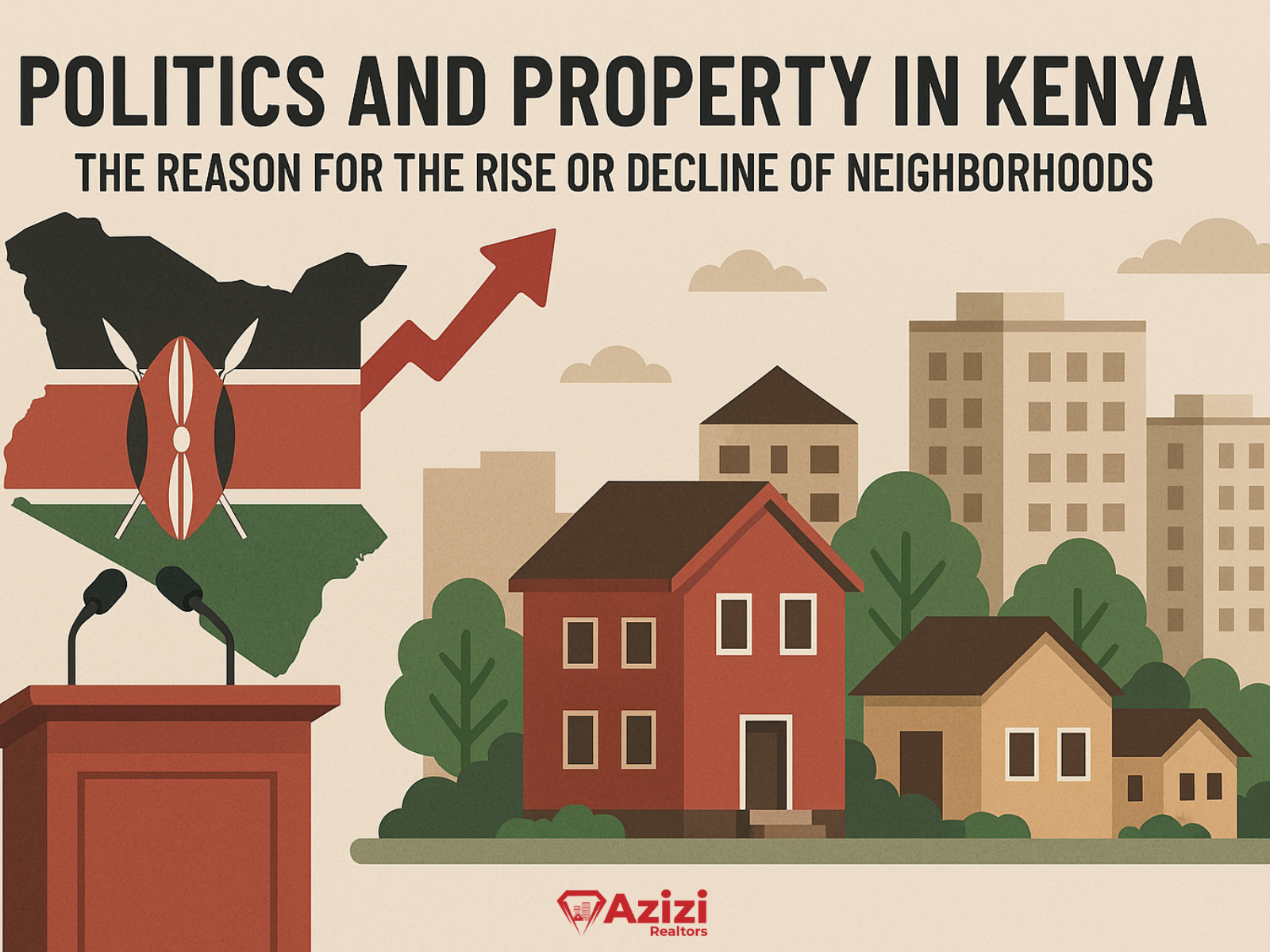
Politics and Property in Kenya: The Reason For The Rise or Decline of Neighborhoods
Case Study: Westlands vs Eastlands, Nairobi
In Kenya, politics and property in Kenya are not separate conversations. They are the same conversation. Similarly, real estate growth rarely happens by accident.
Behind every thriving or supercharged neighborhood lies a combination of:
- Political influence
- Zoning decisions
- Infrastructure investment
- Government prioritization
Likewise, behind every stagnating or stalling neighborhood are years of:
- Policy neglect
- Underinvestment
- Weak urban planning
Simply put:
Politics and property in Kenya are inseparably linked.
From Westlands to Eastlands and Upper Hill, Nairobi provides one of the clearest examples of how political decisions can supercharge one neighborhood while stalling another even within the same city.
This blog explores:
- The deep relationship between politics and property in Kenya
- Whether zoning laws truly apply equally across Nairobi
- How Westlands transformed into a premium real estate hub
- Why Eastlands stagnated despite enormous potential
- How Upper Hill proves the power of political-driven urban transformation
- What this means for investors, developers, and homeowners
Why is the link between politics and property in Kenya Inseparable?
Real estate growth in many developed countries is driven primarily by:
- Market demand
- Private capital
- Long-term planning frameworks
However, in Kenya we see government policies and political power playing a direct role in its growth.
These political decisions influence:
- Where highways, expressways and bypasses pass
- Where public funds are allocated
- Which areas receive sewer, water, and power upgrades
- Which neighborhoods receive rezoning approvals
- Where public institutions relocate
These decisions directly shape:
- Property values
- Long-term appreciation
- Development intensity
- Rental demand
This is why political favors often determine economic fortune.
Is Zoning the Same Across Nairobi?
One of the most common misconceptions we see among our clients is on zoning laws applying uniformly across Nairobi.
The reality is:
Nairobi operates under one planning framework, but zoning intensity, flexibility, and enforcement differ dramatically by location.
How does zoning in Westlands differ from Eastlands
- Westlands zoning policy
Westlands is designated as a high-density mixed-use commercial zone.
This allows it to host:
- Hotels
- High-rise residential apartments
- Office towers
- Entertainment and lifestyle developments
- Shopping malls
This zoning structure allows for:
- Maximization of land utility
- Encourages growth of vertical developments
- Attracts institutional investors
2. Eastlands zoning policy
Large parts of Eastlands remain:
- Predominantly residential
- Light industrial
- Low-rise zoning
This then restricts:
- Vertical construction
- Large-scale commercial projects
- Urban regeneration
The result:
- Slower infrastructure upgrades
- Reduced investor confidence
- Lower land utilization
This zoning disparity perfectly illustrates how politics and property in Kenya shape spatial inequality.
Case Study: Westlands and How Politics Supercharged this Neighborhood
Few places illustrate the interlink of politics and property in Kenya better than Westlands.
In the early 1990s, Westlands wasn’t the “Manhattan of Nairobi” as we see it today. Back then it was:
- A quiet leafy low-density residential suburb
- Characterized by low-rise housing hence small-town atmosphere
- Limited commercial activity
- Zoning laws were strictly residential
Additionally, the shift in land value in Westlands since the early 1990s is staggering, representing some of the highest capital appreciation in Africa.
Why did Westlands grow so rapidly?
1. Strategic political rezoning
Government planning authorities reclassified Westlands from low-density residential to high-density commercial and mixed-use.
This:
- Multiplied development potential
- Attracted multinational capital
- Enabled vertical construction
This single decision fundamentally rewrote Westlands’ economic destiny.
2. Infrastructure investment bias
Westlands received disproportionate public investment in:
- Waiyaki Way expansion
- Nairobi Expressway interchanges
- Drainage and sewer upgrades
- Urban landscaping and walkways
- Power and fiber connectivity
Infrastructure lowered development risk and pulled massive capital inflows.
This is a textbook example of politics and property in Kenya working hand-in-hand.
3. Diplomatic and corporate migration
Political planning relocated many businesses from CBD to Westalands among them:
- Embassies
- NGOs
- Multinationals
- Bank headquarters
This created:
- High-income employment zones
- Strong housing demand
- Rapid commercial expansion
Westlands evolved into Nairobi’s premier business and lifestyle hub.
Case Study: Eastlands and How Political Neglect Stalled Growth
Eastlands includes:
- Buruburu
- Umoja
- Donholm
- Kayole
- Komarock
- Embakasi
Despite housing millions of Nairobi residents, Eastlands remains significantly undervalued.
Why Eastlands Stagnated
1. Infrastructure neglect
For decades, Eastlands has suffered from:
- Poor road networks
- Inadequate drainage
- Weak sewer systems
- Limited transport upgrades
This discouraged:
- Large-scale private investment
- High-value developments
2. Restrictive zoning policies
Most Eastlands neighborhoods remain locked into:
- Low-rise residential zoning
- Limited mixed-use approvals
This:
- Restricts vertical growth
- Blocks urban regeneration
- Keeps land values suppressed
3. Political perception bias
Historically, Eastlands has been perceived as:
A working-class residential zone and not a strategic economic growth corridor.
This perception influenced:
- Budget allocations
- Infrastructure development
- Policy attention
This stark difference between Westlands and Eastlands demonstrates how politics and property in Kenya create both winners and losers.
Upper Hill: Proof That Politics Can Rewrite a Neighborhood’s Future
The clearest evidence of how politics and property in Kenya interact can be seen through Upper Hill.
What it was before the 1990s:
- Quiet residential suburb
- Government housing
- Low-density private homes
- Minimal commercial activity
Land price: ~KES 20M per acre
Upper Hill is now Nairobi’s most expensive land market, proving that politics and property in Kenya can dramatically reshape urban destiny.
Political decisions that changed everything
In the early 1990s, the government:
- Rezoned Upper Hill into a commercial and financial district
- Encouraged banks, hospitals, and institutions to relocate
This was followed by:
- Road upgrades
- Sewer and drainage investments
- Utility expansion
The Nairobi Expressway: A Living Example of Politics in Motion
Few infrastructure projects demonstrate politics and property in Kenya better than the Nairobi Expressway.
Neighborhoods along the expressway:
- Westlands
- South B
- South C
- Syokimau
- Athi River
experienced:
- Rapid land price appreciation
- Increased developer interest
- Rising rental demand
Meanwhile, areas bypassed by the expressway saw no comparable growth effect.
How political decisions create property winners and losers
| Political Action | Real Estate Impact |
| Infrastructure investment | Rapid price appreciation |
| Zoning upgrades | Developer inflow |
| Transit corridors | Rental demand surge |
| Institutional relocations | Commercial boom |
| Political neglect | Market stagnation |
This framework explains how politics and property in Kenya continuously reshape urban wealth patterns.
What This Means for Property Investors in Kenya
Understanding politics and property in Kenya gives investors a strategic advantage.
- Track government infrastructure budgets because where roads go the land prices follow
- Monitoring zoning changes as it precedes explosive growth
- Watch out for institutional relocations. Where corporates or government reloacate, property value will rise.
Emerging political growth corridors in Kenya
Based on infrastructure investment and zoning policy direction:
- Ruiru
- Juja
- Athi River
- Ngong
- Konza Technopolis
These zones represent the next wave of politically driven real estate growth.
Final Thought: In Kenya, Property Is Political
There is no separating politics and property in Kenya.
Neighborhoods rise when:
- Political will aligns
- Infrastructure funding flows
- Zoning enables density
- Planning supports long-term growth
And they stagnate when:
- Neglect dominates
- Policy remains rigid
- Infrastructure bypasses them
Follow the politics — and you will predict property growth.